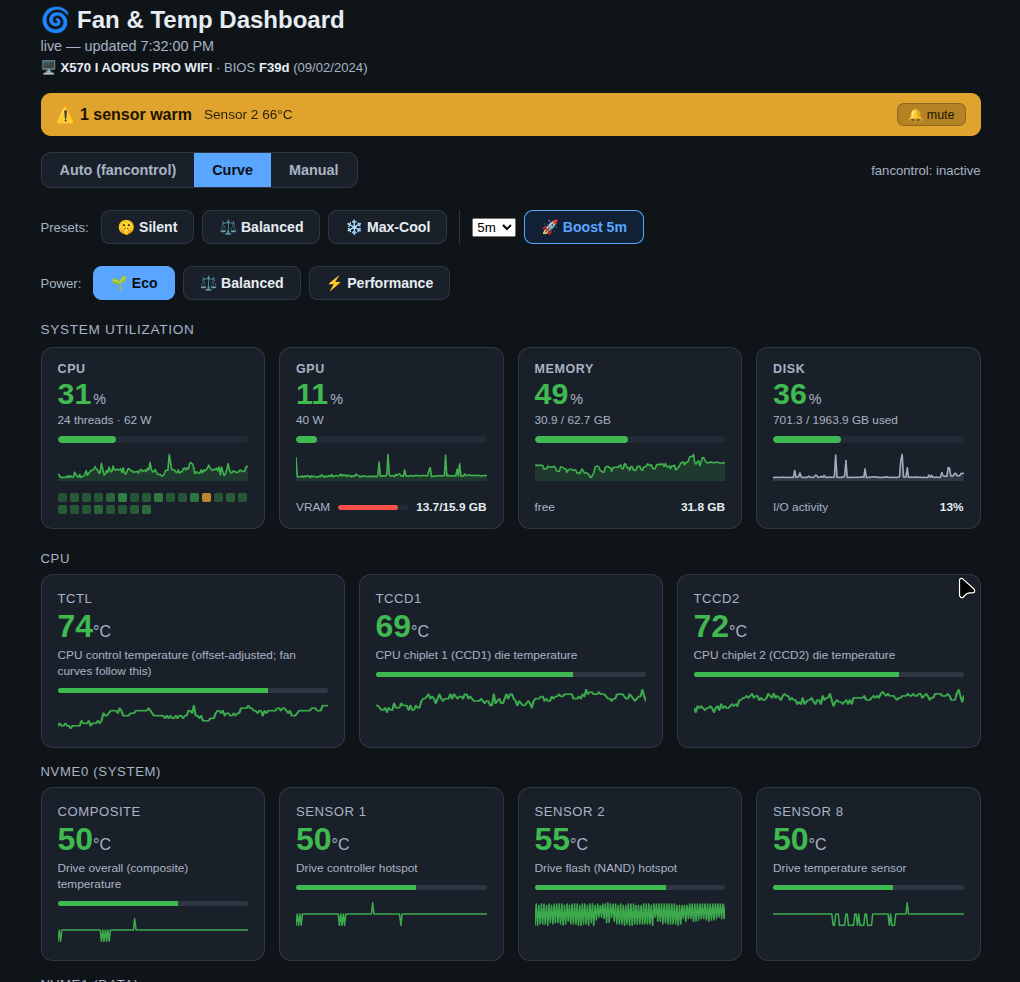
The dashboard in the browser — live temps, fan modes, power profiles, and per-sensor readouts
A workstation's cooling should be something you can see and steer — not a mystery behind a BIOS screen. Open a web page from any device on the network and watch every temperature, fan, and watt live — then drive the fans by hand, by curve, or leave them on autopilot.
The dashboard in the browser — live temps, fan modes, power profiles, and per-sensor readouts
The Fan & Temp Dashboard is a local, browser-based control panel for monitoring and driving a desktop or workstation's cooling. It reads live CPU, GPU, NVMe, and motherboard temperatures, fan speeds, voltages, and power draw, and lets you switch each fan between three modes: fully automatic (handled by the operating system's own fan service), manual sliders, or a custom multi-point software fan curve. The aim is safe, quiet, observable thermal control from any device on the network — a phone on the sofa included — while keeping the OS's native fan service as a crash-safe failsafe. A thermal watchdog forces every fan to maximum above a critical temperature, so losing the app never means losing cooling.
The design is deliberately small and dependency-free:
The feature set is rich for such a compact tool: live temperatures (CPU package and per-core, NVMe composite and hotspot, motherboard rails, GPU), fan RPM readouts with PWM sliders, auto / manual / curve modes, multi-point software curves, and per-fan sensor bindings so a fan can follow the most urgent sensor in a group. On top of that: global and per-fan timed “boost to max”, a thermal watchdog, power telemetry (CPU and GPU watts), utilization and voltage readouts, selectable power profiles (eco / balanced / performance), an editor for the host's fan-control file, and self-healing of stale hardware indices in that file. It even copes with inverted-PWM fans by translating logical duty to raw duty per channel. The stack is Python 3 standard library only — no framework, no packages — with a vanilla HTML/CSS/JavaScript front end, driven over Linux's sysfs/hwmon interface, the relevant super-I/O kernel driver, and the OS fan-control service; a unit-test suite covers the pure curve-and-binding engine. It has been iterated heavily into a working, installable service, recently extracted from a larger repository to stand on its own.